
Every Student Deserves to Feel Welcome and Accepted
by Erik Sievert
When I first started teaching, I believed it was important for students to see teachers like me celebrating their diversity and supporting t...
Classroom Practices / Community & Relationship Building / Continuous Growth / English language learners (ELL) / Math / New To Profession / Nurturing Student Relationships / School Culture / SEL / Student voice / Teacher Leadership / Team-building / Tips from the community
If you are handed a brand-new curriculum, you’re going to be learning new strategies of how to teach students and how to bring the material to life. It’s going to take trial and error, and exploration and experimentation. I think that can be a really vulnerable time for educators. And during this time it’s really so crucial to be able to seek out or provide ourselves with the reassurance that trial and error and experimentation are core to our learning, and our ability to guide students through their own learning process. Developing that perseverance and identifying the strategies you need to succeed are both skills and attitudes every student deeply needs. It’s that empathy for the process of learning and experimentation that fuels my passion for small group instruction.
When I first started implementing small group instruction, my students would typically say something like this: “Mrs. Baney, why are they doing that and we’re doing something different?” And so I realized that providing kids with a compelling answer to that question was incredibly important for fueling their sense of comfort and perseverance with math. This is one of my favorite activities (adapted from a teacher who inspired me!) that does just that.
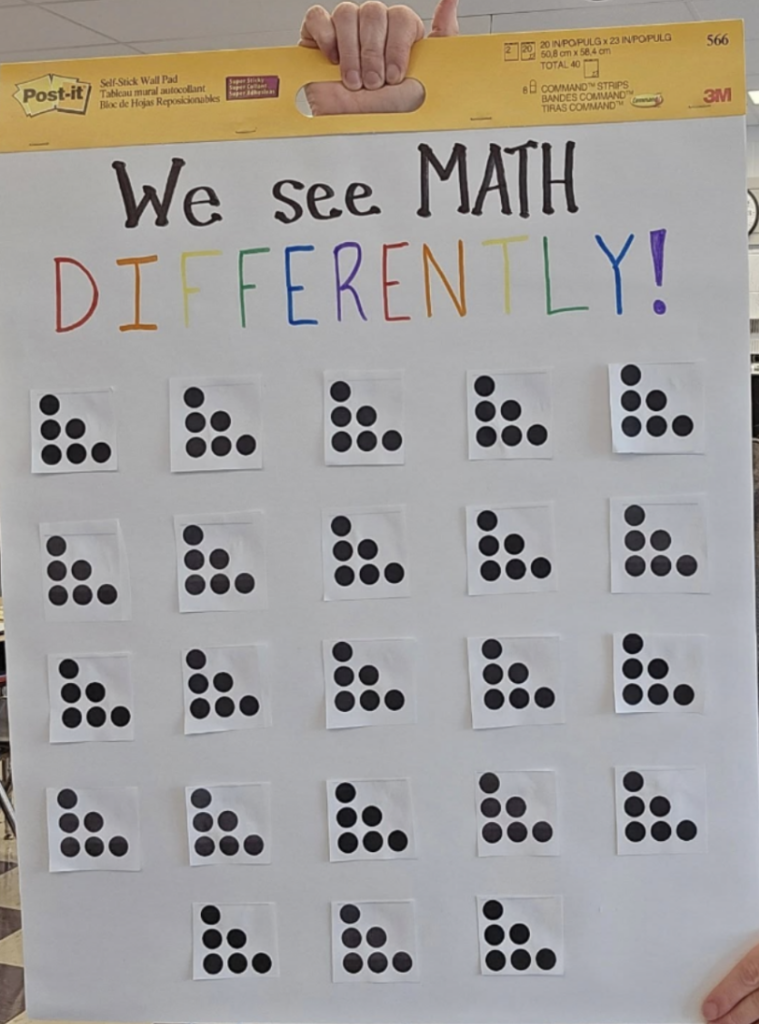
I quickly flash the six dots on our screen, and then it disappears. Students agree that they see six dots. But then I asked each student to describe how they grouped these dots in their brain. As they describe how they grouped the dots to get to six, I model it on this poster (and put their name underneath their section). As they hear their classmates sharing, “Well, I grouped these three dots together first,” and so on, they start to realize that there’s just a multitude of ways to look at six simple dots.
By the end of the activity, the poster is filled with many different approaches to counting up the dots. At this point we can have a really rich conversation about differences in how we perceive information and how we approach problem solving in unique ways – the underlying point being that different strategies may come more naturally or easily to different kinds of math brains. And this is absolutely key: Everyone, every single student in class, has a math brain.
I’ll bring it back to our small groups by saying, “Often, we’ll do the same thing, and you might look at your neighbor and not see them doing the same thing, and I want you to know that that doesn’t mean you’re wrong. There are many different ways that you can solve problems and still come to the same answer.” To really underline the point, we’ll do a couple of examples of just simple problems like addition or multiplication and talk about how just because one person does it one way, it doesn’t mean we all have to do it that way. Instead, there are certain ways that work better for individuals and we’re going to find the way that works for them.
By laying down that foundation, it then really helps carry a positive attitude over to our small groups and helps kids feel like they’re right where they need to be. At any point, if math anxiety or self-doubt start to creep up on a kid, I can say “Hey, remember those six dots? We all see things differently and we need to keep that in mind. We’re going to keep trying different strategies for this problem so we can find the ways we can all be mathematicians – and that means finding what works for you too!”
If this sounds like something you’d like to try with your students, here are a few things I might keep in mind.
1. The school year is full of new beginnings.
The last few years I’ve done this activity right at the beginning of the year. But I think it would be especially cool to try it at the beginning of a unit. If students are expressing some hesitancy around fractions for instance, then that would also be a perfect opportunity to go back to an exercise like this and ask, “What do you see?” “How did you approach this?” But in every case the reminder for the whole class would be, “Look, we just all did this problem a little bit differently, and we’re going to continue to approach things the way that works for us to get those solutions.”
2. It’s OK to share your personal math story.
When my students express feeling discouraged or start to make comments that math “isn’t for them” or they’re not a “math person” I offer up my own math story. As a student, I had an especially tough year where I just felt defeated when it came to math and that I wouldn’t be able to be good at math any more. But then the very next year, I had an amazing teacher who showed me ways to solve the things I was struggling with. Having strategies I hadn’t been exposed to before helped me understand more about my own math brain, and I was able to gain confidence and change my mindset. I say to my class, “And look, I’m now your math teacher.” By sharing that story I can help shatter the myth that some people are good at math, some are bad at math and that’s that. What’s more, my story helps students trust that I’m committed to helping them find what works for their brain.
3. Know the data and know the kids
Often, look at the previous grade level’s state testing results. I use those results to create a foundation of my small groups. Then I start the process of tweaking those groups as I get to know the kids, and as we gather more data together from our quizzes and growth assessments. I’m constantly adjusting our groups according to what I learn and what the kids learn. At the same time, I keep emphasizing that no group is better or worse – and no one gets moved to a different group because they’ve done something wrong or bad. I bring our conversations back to those six dots, and assure every kid that shifting groups is always about helping them grow as a mathematician.
4. Support kids in owning their goals and honoring their progress
We hold small group math chats where every kid has the chance to share their math story of the moment. I’ll ask what feels easy for them in math, and what feels more challenging. From there we can start talking about what they might want to achieve, and I remind them that goals are allowed to be simple! We don’t have to reach for the whole moon right away!
We also have regular data chats, one on one, where we check in around what’s going well, what’s feeling challenging and what ideas we both have for how they might make progress. Being an active participant not only in shaping their goals but in creating a plan to reach them helps bring kids back to their data and away from a rigid sense of being a “math person.”
We’ll have a similar chat if there’s a drastic change from assessment to assessment, and simply take the opportunity to ask, “Hey, what happened here?” Talking about changes like that right away, when we’ve built the habit of regular data chats, changes the conversation from being wrong into trying another strategy for success.
5. Check on kids’ well-being
There is a direct connection between kids’ well-being and what’s happening in their academic work. So one thing that I do every single day of the school year is have a check-in with my students through Google forms. They can send it in and let me know how they’re feeling that day, along with anything else they think I should know. That gives me plenty of opportunity to connect with a kid who might be struggling and help them understand that our brains simply have less space for learning when we’re having a hard time. There’s nothing wrong with their math brain, and they can still succeed. We just need to find them some more support. That’s when I’ll turn to my coworkers and we can activate those resources to help get kids more of what they need, so they can have more brain space for learning.
When I share my math story with kids, I tell them that I hope to be the kind of teacher who helps them find their lightbulb moments. It’s so important for kids to know that meeting a challenge doesn’t mean the end of their math journey, and that there are still plenty of exciting “aha’s” that can light up their brains and change how they imagine the world. I hope this activity can be a spark of inspiration in your practice, so that we can keep exploring how to share the joy of math with every kid.

by Erik Sievert
When I first started teaching, I believed it was important for students to see teachers like me celebrating their diversity and supporting t...

by Beckett Haight
I’m a special educator. One thing that sets me apart from most of my colleagues is that I received special education services myself when ...

by Tracey Enser
A couple years ago, I came across an idea for teaching students the meaning of equity, and I adapted it to make it my own.